How athletes can track macros without counting calories
5 min read Published on
You don't have to weigh every meal to know whether your food fits your training. For most athletes, a daily target for protein, carbs and fat plus a rough estimate per meal is enough to track macros, as long as you glance at what's left before the day is over. The kitchen scale can stay in the drawer.
Why macros tell athletes more than calories
A calorie total tells you how much you ate. It says nothing about whether that food will help rebuild muscle after a heavy squat day or fuel an interval session two days later. The macronutrients do different jobs, and sports nutrition research gives fairly clear ranges for each.
Protein is the building material for muscle repair and growth. The joint position stand of the American College of Sports Medicine and two dietetics associations puts athletes at 1.2 to 2.0 g per kilogram of body weight per day (Thomas 2016). The International Society of Sports Nutrition lands at 1.4 to 2.0 g for building and maintaining muscle with training, spread over the day in servings of about 0.25 g per kilogram, roughly 20 to 40 g (Jäger 2017).
Carbs are the fuel for hard sessions, and their range is wide because it follows training volume. The same position stand suggests 3 to 5 g per kilogram for light training, 5 to 7 g for about an hour of moderate training a day and 6 to 10 g for one to three hours (Thomas 2016). For a 70 kg athlete, that's somewhere around 210 g on a light day and up to 700 g in a big training block.
Fat is the baseline, at 20 to 35 percent of energy (Thomas 2016). In our coaching it's the part of the plate you plan around and leave fairly steady.
Since energy and nutrient needs depend on training volume and intensity and vary from day to day (Thomas 2016), one calorie number for every day of the week misses what an athlete needs to know. If you combine strength and endurance in one plan, as described in our piece on hybrid training, the swing between days can be large.
Why counting every calorie falls apart
Counting calories works for a couple of weeks. Then it gets tedious, because every meal means weighing and typing in numbers. And the precision is partly an illusion. In our experience, a portion guessed by eye drifts from meal to meal, and a nutrition label is an average for the product, so the grams on your screen look more exact than they are.
The bigger problem is the meal you didn't plan. A sandwich at the train station or dinner at a friend's place comes without a label, and nobody is getting out a scale. One gap like that, and a system built on precision stops making sense for the rest of the day.
Paying attention still pays off. A systematic review of 22 studies on self-monitoring of eating and weighing found it consistently associated with success, while rating the evidence as weak because the studies relied on self-report and homogeneous samples (Burke 2011b). The takeaway for training: keep watching what you eat, and let go of the bookkeeping.
How to track macros without a scale
Your hand is a measuring tool you always have with you. A palm-sized piece of chicken or tofu is a protein portion, a fist is a serving of vegetables, a cupped hand holds a carb portion like rice or oats, and a thumb stands for fat such as oil or nut butter. How accurate that is depends on the food. In one study, a finger-width measure beat cups and spoons for foods with a regular shape, while the fist did worse than cups for loose foods like rice (Gibson 2016). The hand is a rough anchor, not a scale.
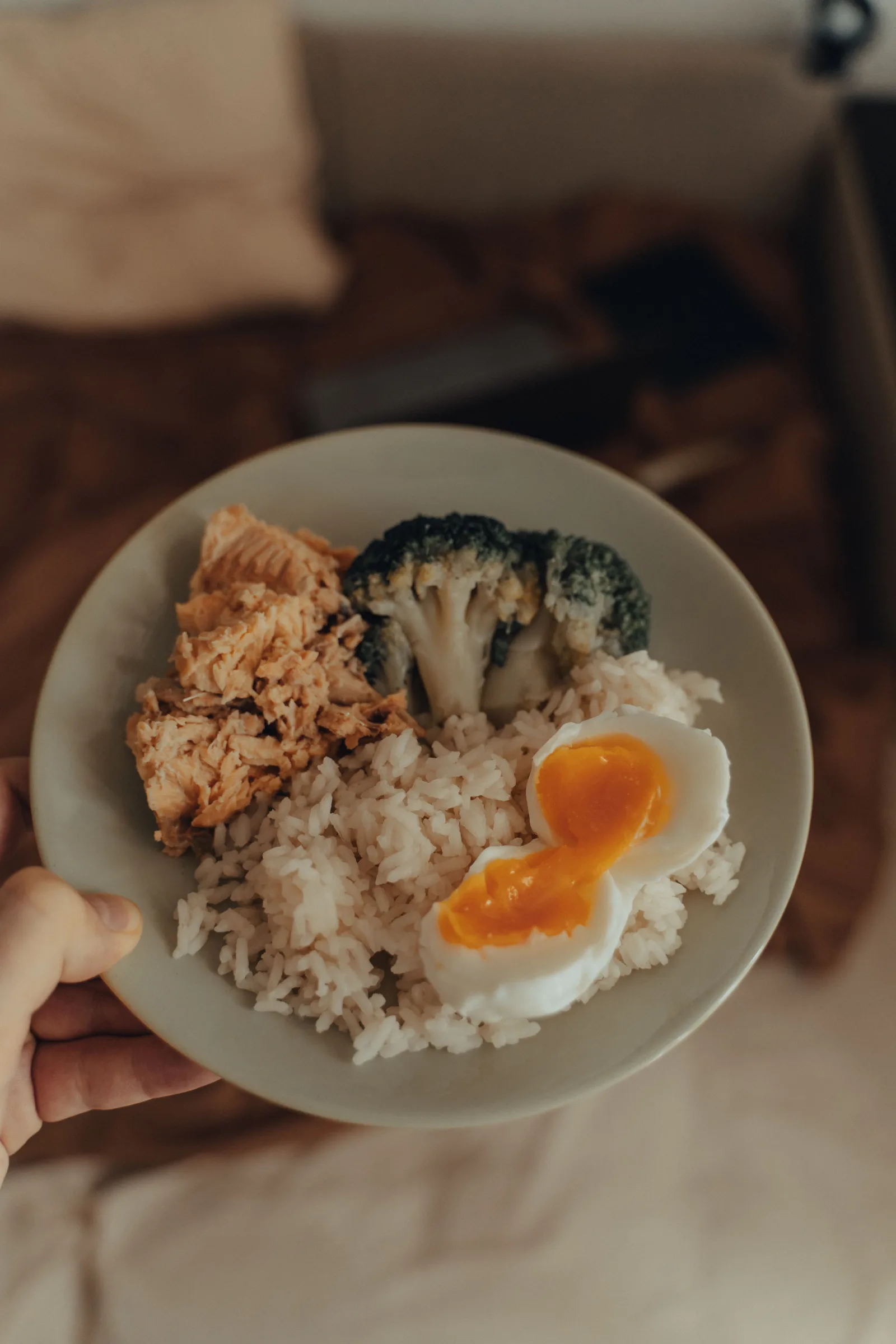
The second tool is your phone. A photo and a short description can stand in for the grams. Image-assisted dietary assessment is an accepted method in nutrition research: photos of meals improve recall and portion estimates compared with plain food records (Boushey 2017). Accuracy depends on the picture, above all on the angle and on something in the frame for scale, and some imprecision remains (Boushey 2017). So calories from a photo are an estimate. For deciding what to eat next, an estimate is usually enough.
Then treat the daily target as a guardrail you steer by over the day. Check it in the afternoon. If most of your protein is still open, dinner gets an extra palm. If you have an evening session and your carbs are low, eat some before you go. A day that ends a little over or under is fine. We look at the week more than at any single meal.
Training days and rest days
Carbohydrate needs follow the training day itself, with more on hard days and less on easy ones (Burke 2011). On a day with intervals or a long ride, carbs move toward the upper part of your range, often as bigger servings before and after the session. On a rest day they come down. By the per-kilogram ranges above, an hour of lifting in the gym usually calls for less than a three-hour ride (Thomas 2016).
Protein doesn't follow that swing. It stays in the same daily range, spread over several servings (Jäger 2017). If that's the number you're least sure about, our article on how much protein you need on training days goes through it in detail. Fat fills in around both.
What a week looks like in Tahto
A week then runs roughly like this. In the morning you see the day's target and your coach's guidance on eating. Meals go in as they happen: a photo of lunch, a quick note about the bar you had on the way to the gym. A ring for calories and three for the macros fill up as you go, and the comments stay plain, like "plenty of protein left" or "save room for after your session". In the evening the daily feedback shows what's still missing. On a Thursday with intervals that target looks different from Sunday's rest day, and you don't have to recalculate anything yourself.
In Tahto
Set up your sports after the download, and the coach builds your first plan.
Sources
- Thomas DT, Erdman KA, Burke LM (2016). Position of the Academy of Nutrition and Dietetics, Dietitians of Canada, and the American College of Sports Medicine: nutrition and athletic performance. Journal of the Academy of Nutrition and Dietetics 116(3), 501-528. https://doi.org/10.1016/j.jand.2015.12.006
- Burke LM, Hawley JA, Wong SHS, Jeukendrup AE (2011). Carbohydrates for training and competition. Journal of Sports Sciences 29(Suppl 1), S17-S27. https://doi.org/10.1080/02640414.2011.585473
- Jäger R, Kerksick CM, Campbell BI, et al. (2017). International Society of Sports Nutrition position stand: protein and exercise. Journal of the International Society of Sports Nutrition 14, 20. https://doi.org/10.1186/s12970-017-0177-8
- Gibson AA, Hsu MSH, Rangan AM, et al. (2016). Accuracy of hands v. household measures as portion size estimation aids. Journal of Nutritional Science 5, e29. https://doi.org/10.1017/jns.2016.22
- Boushey CJ, Spoden M, Zhu FM, Delp EJ, Kerr DA (2017). New mobile methods for dietary assessment: review of image-assisted and image-based dietary assessment methods. Proceedings of the Nutrition Society 76(3), 283-294. https://doi.org/10.1017/S0029665116002913
- Burke LE, Wang J, Sevick MA (2011). Self-monitoring in weight loss: a systematic review of the literature. Journal of the American Dietetic Association 111(1), 92-102. https://doi.org/10.1016/j.jada.2010.10.008